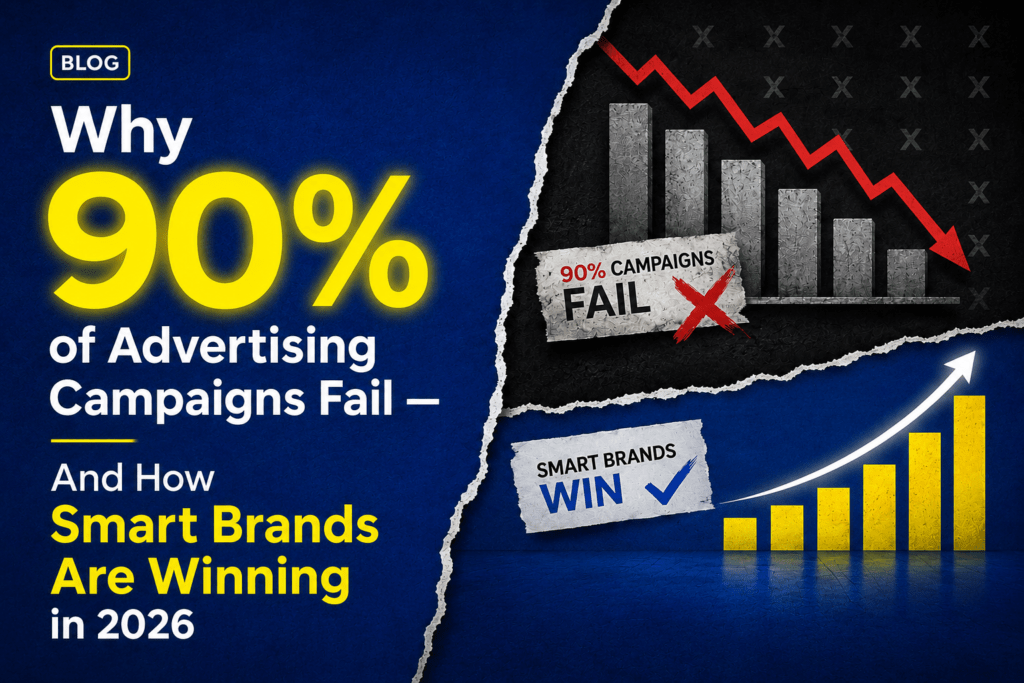
Every year, businesses invest millions into advertising campaigns expecting visibility, engagement, and sales. Yet the reality remains unchanged: a large percentage of campaigns fail to deliver meaningful results. In fact, industry studies consistently show that nearly 90% of advertising campaigns struggle to achieve their intended objectives.
So why do so many campaigns fail?
More importantly, what are successful brands doing differently in 2026?
The answer lies in understanding changing consumer behavior, smarter media choices, and creating consistent brand visibility where audiences actually spend their time.
The Biggest Reasons Advertising Campaigns Fail
- Brands Focus on Reach Instead of Attention
Many businesses are obsessed with impressions and reach numbers. While these metrics may look impressive on reports, they don’t necessarily translate into brand recall or customer action.
Today’s consumers are exposed to thousands of marketing messages daily. Most online ads are skipped, blocked, or ignored within seconds.
The challenge is no longer reaching people — it’s holding their attention long enough to make an impact.
- Overdependence on Digital Platforms
Digital advertising remains important, but competition has become more intense than ever. Rising ad costs, banner blindness, ad blockers, and changing algorithms have reduced effectiveness for many brands.
Businesses that rely entirely on social media and search advertising often find themselves fighting for attention in overcrowded spaces.
- Lack of Consistent Visibility
One of the biggest mistakes advertisers make is expecting instant results from short-term campaigns.
Consumers typically need multiple exposures to remember a brand. When campaigns disappear after a few days, so does the audience’s memory of them.
Consistency is often more powerful than frequency.
- Generic Messaging
Modern consumers value relevance. Generic advertisements that try to appeal to everyone often connect with no one.
Successful campaigns speak directly to a specific audience, addressing their needs, habits, and daily experiences.
- Poor Media Selection
Even the best creative can fail when placed in the wrong environment.
A strong message shown to the wrong audience at the wrong time will always underperform. Smart media planning remains one of the most critical factors in campaign success.
How Smart Brands Are Winning in 2026
While many campaigns struggle, leading brands are adapting to changing consumer behavior and investing in high-visibility channels that generate lasting recall.
They Prioritize Brand Recall
Winning brands understand that visibility creates familiarity, and familiarity drives trust.
Instead of chasing quick clicks, they focus on creating repeated exposure across consumers’ daily journeys. When people repeatedly see a brand in their environment, awareness grows naturally.
They Invest in Transit Advertising
One of the most effective strategies gaining momentum in 2026 is transit advertising.
Unlike digital ads that disappear in seconds, transit media remains visible throughout the day. Buses, metro stations, cabs, auto-rickshaws, and other moving formats create continuous exposure across high-traffic areas. For brands targeting urban markets, OOH branding in Delhi NCR has become a particularly powerful tool — putting messaging in front of millions of commuters and residents every day.
This allows brands to reach audiences during their daily commute, shopping trips, and work schedules. The strength of transit advertising lies in its ability to deliver repeated impressions without interrupting the consumer experience.
They Build Omnichannel Campaigns
Successful marketers no longer view advertising channels separately.
Instead, they combine digital campaigns with outdoor media, influencer marketing in Delhi NCR, and transit advertising to create a unified brand presence.
This integrated approach improves recall and reinforces messaging across multiple touchpoints — from a morning commute to an evening scroll through social media.
They Focus on Real-World Visibility
As digital spaces become increasingly crowded, physical-world advertising is becoming more valuable.
Consumers trust brands they regularly encounter in their environment. Investing in retail branding in Delhi NCR — across malls, high-street markets, and commercial hubs — provides exactly this kind of credibility, because it places brands at the precise moment consumers are ready to make decisions.
They Measure Beyond Clicks
Forward-thinking brands understand that not every marketing success can be measured through clicks alone.
Metrics such as brand awareness, recall, reach, market penetration, and customer perception are becoming equally important indicators of campaign effectiveness.
Why Transit Advertising Is Becoming a Strategic Advantage
Consumers spend significant time outside their homes — commuting, shopping, traveling, and working.
This creates countless opportunities for brands to connect with audiences through strategically placed media.
Modern transit advertising delivers:
- High visibility across urban areas
- Continuous brand exposure
- Strong local targeting
- Cost-effective reach
- Improved brand recall
- Wider audience coverage
For businesses looking to increase awareness and remain visible throughout the customer journey, transit-based media has become a powerful complement to digital advertising.
Final Thoughts
Advertising failure rarely happens because of poor creativity alone. More often, campaigns fail because brands choose the wrong channels, chase short-term metrics, or fail to create consistent visibility.
The brands winning in 2026 are thinking differently. They focus on attention rather than impressions, brand recall rather than clicks, and visibility rather than interruption.
By combining digital strategies with high-impact outdoor and transit solutions, businesses can create campaigns that stay memorable long after consumers have scrolled past their screens.
If your goal is to build stronger brand awareness and reach audiences throughout their daily journey, now is the time to rethink where your advertising appears — and how often your audience truly sees it.
