
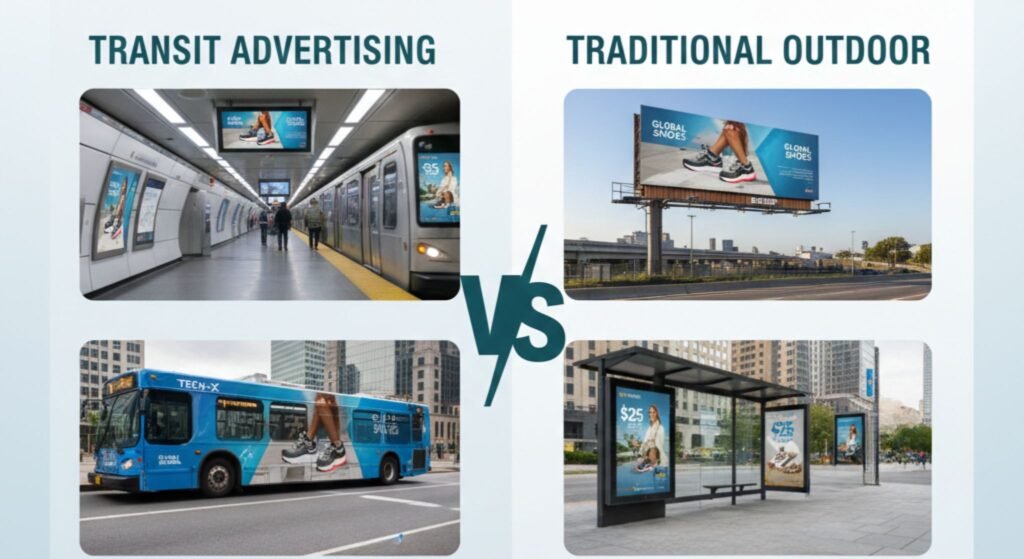
In today’s fast-evolving marketing environment, brands are constantly looking for advertising channels that offer strong visibility, measurable impact, and high returns on investment. Among Out-of-Home (OOH) marketing options, transit advertising and traditional outdoor advertising remain two of the most powerful tools for reaching mass audiences. While both formats play a crucial role in brand building, understanding their differences can help marketers make smarter budget decisions.
Traditional outdoor advertising typically includes large billboards, hoardings, gantries, unipoles, and static displays placed at strategic locations such as highways, intersections, and commercial hubs. These formats are known for their premium presence and strong visual impact. For brands focusing on OOH branding in Delhi NCR, outdoor hoardings can create a sense of credibility and authority, especially when placed in high-profile locations. However, the effectiveness of traditional outdoor advertising is heavily dependent on location quality, traffic volume, and dwell time. Since the ads are static, their reach is limited to audiences passing through that particular spot.

In contrast, transit advertising leverages moving vehicles such as buses, metros, taxis, and auto-rickshaws as advertising platforms. This format transforms daily commuting routes into mobile billboards, enabling brands to reach multiple neighborhoods, business districts, and residential areas in a single day. In a bustling region like Delhi NCR, where millions commute daily, transit media ensures repeated exposure across diverse audience segments. This high frequency makes transit media advertising especially effective for building brand recall and awareness.
When it comes to ROI, transit advertising often stands out for its cost-effectiveness and extensive coverage. Traditional outdoor media usually involves high rental and production costs, particularly for premium locations. Transit campaigns, on the other hand, offer flexible pricing models and the ability to scale campaigns across multiple routes and zones. This makes transit media a popular choice for brands working with an advertising company in Delhi NCR that want maximum reach without overshooting their budgets.
That said, traditional outdoor advertising still holds significant value. Large-format hoardings deliver strong visual dominance and are ideal for high-end brands aiming for prestige and long-term brand positioning. Transit ads excel in frequency and mobility, while static outdoor ads excel in impact and stature. Therefore, the most effective out of home advertising strategy often involves a combination of both formats.

For marketers planning OOH marketing in India, the key is to align media selection with campaign goals. If the objective is widespread awareness and repeated impressions, transit advertising provides excellent value. If the goal is premium branding and landmark visibility, traditional outdoor media is a better fit. By integrating both approaches, brands can maximize brand visibility through outdoor advertising and achieve stronger campaign performance.
In conclusion, there is no one-size-fits-all answer to which format delivers better ROI. Transit advertising offers broader reach and cost efficiency, while traditional outdoor provides premium impact and brand credibility. A balanced mix of both ensures brands remain visible, memorable, and competitive in today’s crowded advertising landscape.
