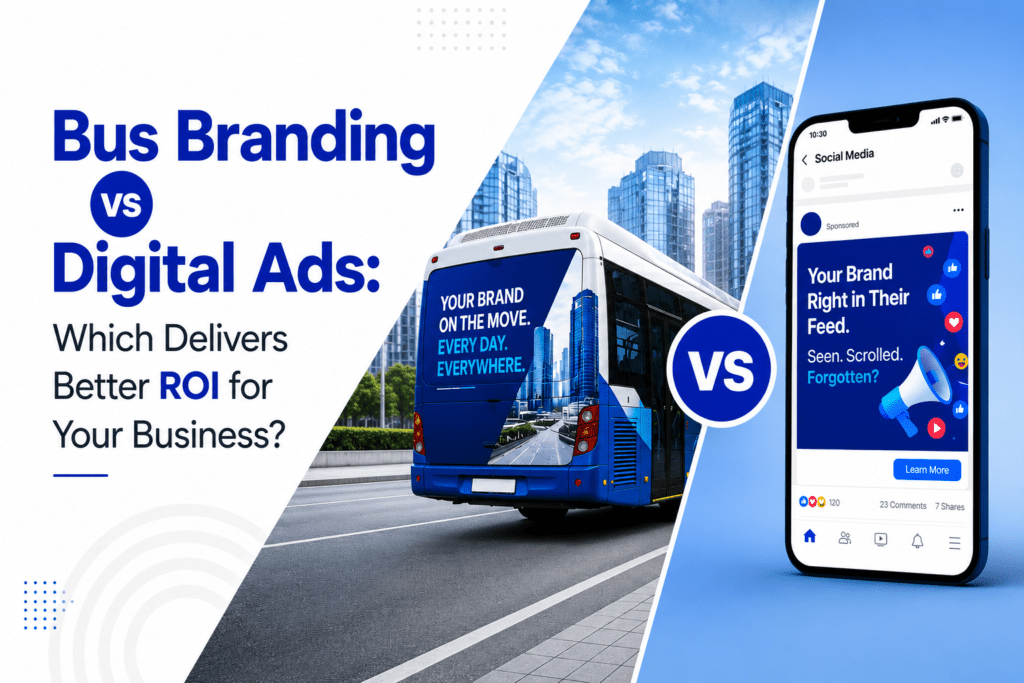
Every marketer has faced this question at least once: should we put our budget into digital ads or go old-school with outdoor advertising? And while the debate has been going on for years, the answer is rarely black and white — especially in a market as dynamic and diverse as India.
Let’s break it down honestly, because your marketing budget deserves more than a gut feeling.
The Case for Digital Ads
There’s no denying that digital advertising has reshaped how brands connect with their audiences. You can target by age, location, interest, device, and even the time of day someone last visited your website. Platforms like Google, Meta, and YouTube offer granular analytics — impressions, clicks, conversions, cost-per-acquisition — all in real time.
For businesses with tight budgets and niche audiences, digital can feel like a precision tool. You set a daily cap, run an A/B test, tweak your creative, and pivot within 24 hours if something isn’t working.
But here’s what the metrics don’t always show: digital fatigue is real. The average Indian internet user sees hundreds of ads per day. Banner blindness, ad blockers, and skip buttons mean that even well-funded campaigns often struggle to earn more than a few seconds of genuine attention. And with rising CPCs across major platforms, the cost of digital ads has been climbing steadily — making ROI harder to justify for awareness-stage campaigns.
Enter Bus Branding — The Mobile Billboard You Can’t Skip
Now think about this: a fully branded bus rolling through Connaught Place, Karol Bagh, or Cyber City during peak hours. No skip button. No ad blocker. No algorithm deciding whether your creative gets seen.
Bus branding in Delhi NCR has quietly become one of the most powerful tools in a brand’s outdoor arsenal — and for good reason. Delhi’s public bus network, including DTC and cluster buses, covers thousands of kilometres daily across densely populated routes. A single branded bus can generate anywhere between 30,000 to 50,000 impressions per day, depending on the route and time of operation.
That’s not a digital estimate based on 3-second views. Those are real people — commuters, pedestrians, other motorists — physically seeing your brand on the move.
What makes bus branding in Delhi NCR particularly compelling is its ability to build consistent brand recall without requiring the audience to actively seek out your content. Repetition is the backbone of brand awareness, and a bus that passes through the same localities day after day quietly embeds your brand into the everyday lives of your target audience.
OOH Branding in India: A Growing Force, Not a Fading One
There’s a common misconception that OOH branding in India is a legacy medium — something reserved for big FMCG players with bottomless budgets. That narrative is changing fast.
The Indian OOH industry has been growing at a healthy pace, increasingly powered by smarter placement strategies, creative executions, and route-based targeting. Brands like Swiggy, Bajaj, KFC, and McDonald’s — none of them exactly small names — have made transit and outdoor advertising a core part of their media mix, precisely because it reaches audiences that digital sometimes misses: people who are offline, on the move, or simply exhausted from staring at screens.
OOH branding in India also carries an inherent trust factor. There’s something psychologically grounding about seeing a brand in the physical world. It signals investment, commitment, and presence — qualities that click-through rates simply can’t communicate.
So, Which One Has Better ROI?
Here’s the real answer: it depends on what ROI means for your business at this particular stage.
If you’re running a performance marketing campaign to drive e-commerce conversions or app installs, digital is your best bet. The attribution is cleaner, and you can optimize in real time.
But if your goal is brand awareness, recall, and local market penetration — especially in a metro like Delhi — outdoor and transit advertising often delivers a far better cost-per-impression and a much higher quality of attention.
The smartest brands don’t choose between the two. They use bus branding in Delhi NCR and outdoor media to build the brand, and digital channels to convert the curiosity that outdoor creates. It’s a flywheel — each medium amplifies the other.
The Transit Advertising Advantage
At Transit Advertising, we’ve worked with brands across categories — from fintech to food delivery to consumer electronics — and one thing is consistent: the brands that integrate outdoor touchpoints into their marketing mix see stronger brand equity over time.
Whether it’s a full bus wrap rolling through South Delhi or a targeted OOH campaign across high-footfall corridors in NCR, we bring strategy, creative, and on-ground execution together — so your campaign doesn’t just look good on a brief but actually delivers in the real world.
OOH branding in India is not just about filling up empty surfaces. It’s about showing up where your audience lives, commutes, and breathes — and making sure your brand is the one they remember.
