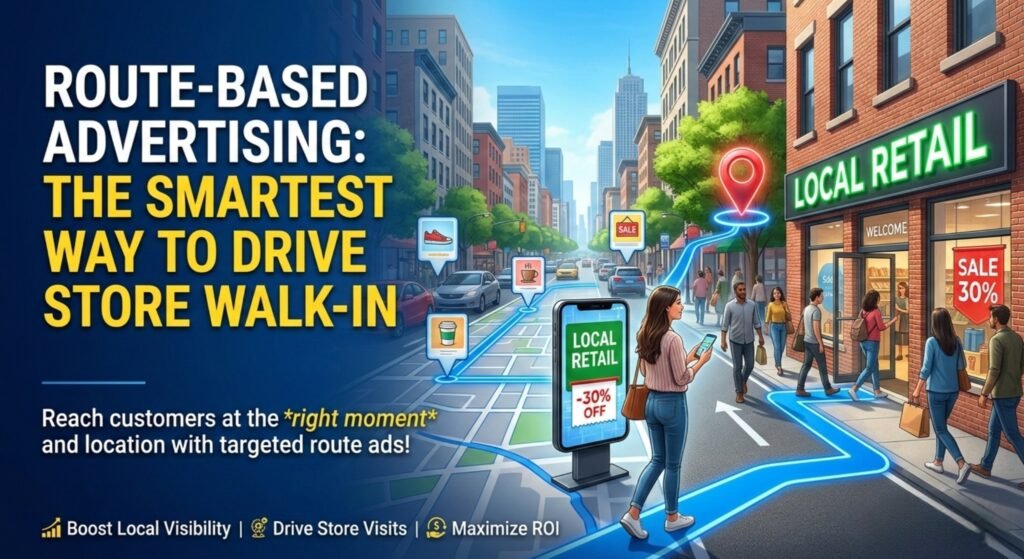
In today’s hyper-competitive retail environment, brands are constantly looking for ways to convert visibility into real footfall. Digital ads bring clicks, but not always customers. Billboards offer reach, but sometimes lack targeting. This is where Route-Based Advertising emerges as one of the smartest and most practical strategies to drive store walk-ins and offline conversions.
Route-based advertising focuses on placing brand messages along the daily travel routes of your target audience—from home to office, metro stations, bus stops, highways, and shopping districts. By reaching people repeatedly during their commute, brands can influence purchasing decisions at the exact moment when consumers are most likely to visit a nearby store.
For retailers, restaurants, malls, and local businesses, this approach creates a powerful bridge between brand visibility and physical store traffic.
What is Route-Based Advertising?
Route-based advertising is a location-driven marketing strategy where brands place advertisements along key travel corridors that their target audience frequently uses.
Instead of advertising randomly across a city, brands strategically select routes that connect high-density residential areas, business districts, shopping hubs, and transit stations. These routes often include:
- Major roads and highways
- Metro station entry/exit points
- Bus shelters and transit media
- Flyovers and traffic junctions
- Pedestrian walkways
- Parking areas near shopping districts
Because commuters travel the same routes daily, they encounter the same brand messages repeatedly. This frequency of exposure builds familiarity and recall, which significantly increases the chances of a store visit.
Why Route-Based Advertising Works So Well for Retail
Consumers rarely make completely spontaneous shopping decisions. Instead, their choices are influenced by convenience, familiarity, and proximity.
Route-based advertising taps directly into these psychological triggers.
1. Captures Consumers During Daily Commutes
Most people follow predictable travel patterns—home to office, office to gym, gym to home. By placing advertisements along these routes, brands reach consumers multiple times a day.
Repeated exposure during commutes creates strong brand recall. When the consumer decides to shop, your store becomes the first option that comes to mind.
2. Drives Immediate Store Visits
Unlike digital ads that require an additional step to convert, route-based advertising places your message physically close to the point of purchase.
For example:
- A restaurant ad near an office cluster influences lunch decisions
- A clothing store ad near a mall encourages weekend shopping
- A pharmacy ad near a residential area drives quick visits
When advertising appears minutes before a purchase opportunity, the chances of store walk-in increase dramatically.
3. Repetition Builds Brand Trust
Marketing studies show that consumers often need 7–10 exposures to a brand before taking action.
Route-based advertising naturally provides this frequency. If someone passes the same metro station or traffic signal every day, they see your brand repeatedly.
This repetition builds:
- Familiarity
- Credibility
- Trust
Eventually, the brand feels reliable and recognizable, making it easier for consumers to choose your store.
4. Perfect for Hyperlocal Marketing
For retail brands, hyperlocal visibility is critical.
Route-based campaigns allow businesses to focus on specific neighborhoods and catchment areas rather than advertising across an entire city.
For example:
- A gym can advertise along routes within a 5 km radius
- A restaurant can target office commuters
- A retail store can dominate the roads leading to a mall
This precision ensures that advertising budgets generate real footfall instead of wasted impressions.
Best Locations for Route-Based Advertising
Not all locations are equal when it comes to route-based campaigns. The most effective placements are those that combine high traffic, long dwell time, and proximity to retail areas.
Metro Stations
Metro commuters represent high-value urban consumers. Advertising at entry gates, staircases, and platforms ensures repeated exposure to thousands of passengers daily.
Traffic Junctions
Busy intersections create natural dwell time because vehicles stop at signals. This gives commuters more time to absorb the advertisement.
Bus Shelters
Bus stops attract both commuters and pedestrians. People often wait several minutes, making it an ideal moment for message engagement.
Flyovers and Arterial Roads
These routes carry high traffic volumes, allowing brands to achieve massive reach across the city.
Near Shopping Districts
Advertising near malls or retail clusters influences last-mile purchase decisions, which is crucial for driving walk-ins.
Industries That Benefit Most from Route-Based Advertising
While route-based marketing works for many sectors, some industries benefit particularly well.
Retail Stores
Clothing brands, electronics stores, and lifestyle outlets can guide consumers directly to nearby locations.
Restaurants and Cafés
Food decisions are often spontaneous. Advertising along office commute routes can increase lunch and dinner visits.
Malls and Shopping Centers
Route-based advertising helps malls attract shoppers from surrounding neighborhoods.
Gyms and Fitness Centers
Fitness businesses rely heavily on local members. Targeting nearby commuters increases membership inquiries.
Real Estate
Developers often advertise along routes leading to residential areas or office hubs to capture potential buyers.
Key Elements of a Successful Route-Based Campaign
To maximize effectiveness, route-based advertising requires thoughtful planning.
Strategic Route Mapping
Identify routes with the highest concentration of your target audience. Consider:
- Residential clusters
- Corporate hubs
- Transit corridors
- Retail zones
Mapping commuter behavior ensures the campaign reaches the right audience repeatedly.
Clear Directional Messaging
One powerful tactic in route-based campaigns is directional advertising.
Examples include:
- “Store 500 meters ahead”
- “Next left for exclusive offers”
- “Visit our showroom at the next signal”
This creates real-time navigation to your store.
High-Impact Visual Design
Commuters only have a few seconds to notice an advertisement.
Effective route-based creatives use:
- Bold colors
- Large fonts
- Minimal text
- Strong brand imagery
Simplicity ensures the message is instantly understood.
Consistent Branding Across the Route
When consumers see the same brand across multiple points in a route, it creates a dominant visual presence.
This technique, often called route domination, dramatically increases brand recall.
Route-Based Advertising vs Traditional Outdoor Advertising
| Feature | Traditional Outdoor Ads | Route-Based Advertising |
| Targeting | Broad city-wide | Specific commuter routes |
| Frequency | Random exposure | Repeated exposure |
| Conversion | Awareness focused | Walk-in focused |
| Local impact | Moderate | Very high |
| Relevance | Generic | Hyperlocal |
This comparison clearly shows why route-based advertising is becoming the preferred strategy for retail-driven campaigns.
The Rise of Transit Media in Route-Based Campaigns
Modern route-based advertising often integrates transit media for maximum reach.
Transit advertising includes placements on:
- Metro trains
- Station branding
- Bus wraps
- Bus shelters
- Airport transit zones
Because transit systems move through multiple high-density locations, they provide continuous brand exposure across the city.
For retailers, transit media acts like a moving billboard network, reinforcing brand recall across commuter journeys.
