
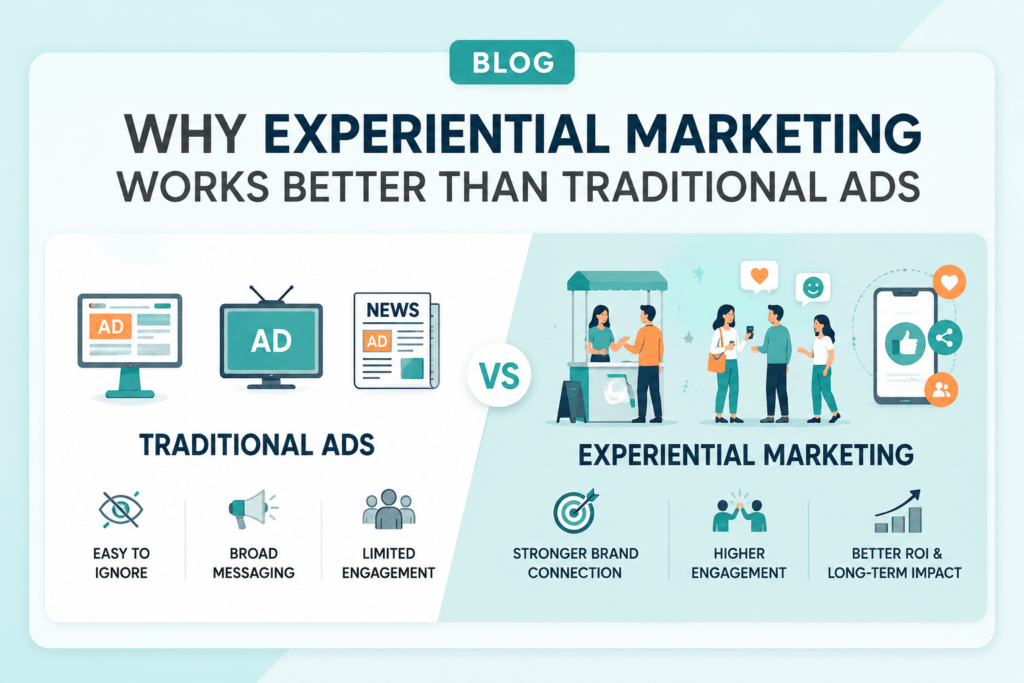
Consumers today see advertisements everywhere — on mobile screens, websites, television, social media, and even while travelling. Because of this constant exposure, traditional advertising is slowly losing its impact. People often skip ads, ignore banners, or scroll past promotional content without paying attention.
This is why experiential marketing has become one of the most effective ways for brands to connect with their audience.
Experiential marketing focuses on creating real and memorable interactions between brands and consumers. Instead of simply showing a message, it allows people to experience the brand directly through live activations, events, product demonstrations, transit campaigns, mall promotions, and interactive outdoor advertising.
The biggest advantage of experiential marketing is emotional connection. People remember experiences far more than ordinary advertisements. When customers actively participate in a campaign, they feel more connected to the brand. A creative on-ground activation or an engaging public campaign leaves a lasting impression that traditional ads often fail to create.
Another reason experiential marketing works better is audience engagement. Traditional advertising is usually one-sided — brands talk, and consumers listen. Experiential campaigns, however, encourage participation. Whether it is trying a product, attending a live event, or interacting with a branded setup, customers become part of the campaign itself. This increases interest, engagement, and overall brand recall.
Experiential marketing also performs exceptionally well in the age of social media. People enjoy sharing unique experiences online. A creative activation or visually appealing campaign can quickly gain attention through Instagram stories, reels, videos, and user-generated content. This helps brands reach a much larger audience organically without depending entirely on paid advertising.
Trust is another major factor. Modern consumers are more skeptical of direct advertising claims. Experiential marketing feels more authentic because people can interact with the brand personally. Instead of being told why a product is good, customers get the opportunity to experience it themselves, which builds confidence and credibility.
For businesses looking to stand out in a competitive market, experiential marketing offers a stronger and more memorable approach than traditional advertising. It combines creativity, interaction, and emotional impact to create meaningful customer relationships.
At Transit Advertising, brands can leverage innovative experiential marketing strategies, transit advertising, outdoor branding, and on-ground activations to create campaigns that truly connect with audiences and deliver long-term brand value.
In a world where consumers are overwhelmed with advertisements every day, experiences are what people remember most. That is exactly why experiential marketing continues to outperform traditional advertising.
